Russia tightening the screws...although it would be a mistake to conclude that it is operating from a position of strength.
Like the Secretary of Defense, Robert Gates, has said (regarding how Prime Minister Nikita Khrushchev was embarrassed that then President Dwight D. Eisenhower's plane was bigger than his). "I mean, this is pretty deep-seated stuff, and so trying to avoid touching on one of Russia's insecurities is almost impossible,".
January 8, 2009
Ukraine Says Russia Shuts Down All Gas Supplies to Europe
By DAVID JOLLY and ANDREW E. KRAMER
PARIS — All gas supplies to Europe via Ukraine were shut down Wednesday as the pricing dispute between Russia and Ukraine escalated. The European Union called for an immediate solution to the crisis.
The cutoff showed the first signs of hitting the European economy as the Hungarian unit of the Japanese automaker Suzuki said it was halting production because of restrictions on industrial users of gas. The Hungarian news agency MTI quoted a spokeswoman as saying Suzuki hoped to restart production Monday.
The Ukrainian gas company Naftogaz accused Gazprom, the Russian gas monopoly, of halting all transshipments at 7:44 a.m. Wednesday. But in Berlin, Aleksandr I. Medvedev, Gazprom’s deputy chief executive, told journalists that it was Naftogaz, the Ukrainian company, that had closed a fourth pipeline, ending all transshipments to Europe.
“Unfortunately, the situation is continuing to deteriorate,” Reuters quoted Mr. Medvedev as saying. “Yesterday night, Ukraine completely shut down all export pipelines to Europe via Ukraine.”
Jose Manuel Barroso, the president of the European Commission, called Prime Minister Vladimir V. Putin of Russia and the Ukrainian prime minister, Yulia Timoshenko, to urge that they quickly restore the flow of gas, a spokeswoman for the commission said in Brussels. The spokeswoman said Mr. Barroso told the leaders that it was unacceptable that Europe be a hostage to their dispute. Mr. Barroso also suggested the European Union was willing to send observers to monitor the flow of gas to Europe, if requested.
The shutdown left Slovakia, the Czech Republic, Austria, Hungary and Romania with no Russian gas supplies amid a bitter cold snap across much of the continent. European Union countries have access to some other sources of gas — including Russian gas from other pipelines, and gas produced in Britain, Norway and the Netherlands — but the loss of the Ukrainian pipeline puts the European Union under pressure to push for a solution.
The cutoff began Tuesday, causing shortages from France to Turkey. Gazprom said Ukraine was siphoning off for itself supplies destined for Europe, and that Russia would reduce shipments by an equivalent amount. Russia had already halted all supplies to Ukraine for domestic use, saying its western neighbor was not paying enough for the fuel.
Gazprom is seeking to raise the price Ukraine pays for gas to $450 per 1,000 cubic meters from $179.50 last year. It also wants to collect what it says are fines for late payments on previous shipments.
In Vienna, the Austrian gas company OMV said Wednesday it was no longer receiving any Russian gas, after its deliveries fell 90 percent Tuesday.
Viktor A. Yuschenko, the Ukrainian president, called for immediate talks in Moscow to restart the flow.
The European Commission said Tuesday that the situation was “completely unacceptable” and called for the immediate restoration of the gas supply. Europe depends on Russia for 40 percent of its imported fuel.
Gazprom officials in Moscow did not immediately respond to requests for comment. Wednesday is the Orthodox Christmas holiday.
While each side blamed the other for the scope of the latest drop in gas shipments, Russia’s prime minister, Vladimir V. Putin, had personally announced Monday evening on state television that he was ordering a sharp reduction in gas flows, saying Ukraine was siphoning gas from the pipelines without paying.
For Mr. Putin, the escalation comes at a perilous time, as slumping energy prices threaten the fiscal health and political stability that have underpinned his popularity at home.
Some analysts of Russian politics had expected Mr. Putin to become more conciliatory as energy prices fell. Instead, he has taken a hard line in seeking to raise gas prices in Ukraine and perhaps create panic-buying on the international market, where prices of natural gas and oil, Russia’s leading exports, have fallen sharply in recent months.
“They’re still playing hardball, when they have to realize the rules have changed,” Marshall I. Goldman, a senior scholar in Russian studies at Harvard and the author of the recent book “Petrostate: Putin, Power and the New Russia,” said in a telephone interview. “It happened so quickly that I don’t think they’ve had time to realize the implications.”
With temperatures plunging, European leaders expressed mounting concern. Some countries announced rationing for industrial customers to reserve enough heating for residential buildings.
A spokesman for the European Commission said that the cut had come “without prior warning and in clear contradiction of the reassurances given by the highest Russian and Ukrainian authorities,” adding, “This situation is completely unacceptable.”
The cutoff appears to have multiple aims.
Ukraine has angered Russia by seeking membership in the North Atlantic Treaty Organization, as has Georgia, a country Russia fought a brief war against last summer.
Mr. Putin is also under heavy pressure domestically. Oil and gas exports provide about 60 percent of the Russian budget; oil prices, meanwhile, have fallen by about two-thirds since their peak last summer.
The effects are rippling through the economy. The ruble is being devalued, Russian companies are facing bankruptcy and the government’s huge budget surplus will turn into a deficit next year if prices do not rebound, analysts say.
At the same time, Russia’s relations with the West slumped to post-cold-war lows after Russia sent troops into Georgia in August.
Even as Russia will need foreign investment to offset dwindling energy export revenues, options are dwindling for attracting investors to a country that even in the best of times had a poor track record of property rights.
“The Russian elite mind-set right now is a residue of petro-confidence slamming into the financial crisis,” said Cliff Kupchan, a director at the Eurasia Group, a global risk-consulting firm based in New York. “So in my view, they’re confused about whether to seek help from the international financial system to solve their problems that way or continue a bare-knuckled approach to the world.”
Gazprom is seeking to raise the price Ukraine pays for gas to $450 per 1,000 cubic meters, from $179.50 last year.
It also wants to collect what it says are fines for late payments on previous shipments.
Ukraine has in turn demanded that Gazprom pay more to transship gas to Europe.
Executives of Gazprom blamed Ukraine. In an announcement on Monday, Mr. Putin and Gazprom’s chief executive, Aleksei B. Miller, said they would cut 65.3 million cubic meters of gas supplies for Europe. In fact, the reduction totaled about 240 million cubic meters, according to Gazprom.
Company officials said that they had intended to ship more fuel on Tuesday, but that Ukraine had blocked export pipelines. Ukrainian energy officials denied this.
“We are shocked that we’re not in the position to bring gas to the border of Ukraine because they shut down the pipelines,” Mr. Medvedev, a deputy chief executive of Gazprom, said at a news conference in London on Tuesday. “There is no reason to blame Russia or Gazprom.”
Oleh Dubyna, the director of Ukraine’s national energy company, Naftogaz, said he would fly to Moscow on Thursday to resume negotiations.
Gazprom’s spokesman, Sergei V. Kupriyanov, said the company was “ready to begin negotiations at any moment.”
A compromise may be harder to find this year, Thane Gustafson, an expert on Russian energy at Cambridge Energy Research Associates of Massachusetts, said in a telephone interview from Washington. “We’re talking about two sides that are under extreme constraint,” he said.
Among the pipeline routes that were affected the most was the so-called Western Balkan route, affecting supplies to Romania, Bulgaria, Macedonia, Greece and Turkey, said Ferran Tarradellas, a spokesman for the European Union energy commissioner, Andris Piebalgs.
Substantial cuts could also affect Slovakia, Hungary, Slovenia, Italy and Austria, Mr. Tarradellas said.
In Turkey, flows of gas through a pipeline that runs from Ukraine stopped completely on Tuesday morning, said the country’s energy minister, Hilmi Guler. The pipeline is a major source of gas for Turkey, which imports nearly all its energy.
Several other sources, including the Blue Stream pipeline, which carries gas to Turkey from Russia under the Black Sea, were unaffected, however.
David Jolly reported from Paris, and Andrew E. Kramer from Moscow. Reporting was contributed by James Kanter from Brussels, Dan Bilefsky from Prague, Sabrina Tavernise from Istanbul, and Ellen Barry from Moscow.
Wednesday, January 07, 2009


Monday, January 05, 2009
The opposite is equally likely.

When there are "strong" conclusion arcs presented by journalists, politicians and (most of all) academics, I always make time to question assumptions, introduce counter-factual scenarios, and attempt to determine if an opposite conclusion can rest on the same premises.
A good example of this is contained in the below article. The history of China has several examples of periods characterized by rapid international engagement, followed by economic success, followed by a disillusionment, followed by a "re-boot" (typically achieved through violence) to more traditional political and economic structures. There is a non-zero probability that China will simply replay the early 1900s (or the late 1800s, the early 1600s, the late 1500...etc.).
Again, I believe the compass of the United States influence will point towards the antipodes. China will certainly be a power, but not to the extent the current meme suggests.
http://search.japantimes.co.jp/print/eo20090103fc.html
China key to U.S. foreign policy success
By FRANK CHING
U.S. President-elect Barack Obama, asked about his foreign policy priorities when named Person of the Year by Time magazine, listed nuclear proliferation, climate change and global poverty as well as Iraq, Afghanistan, Iran, the trans-Atlantic alliance, Russia, the Israeli-Palestinian conflict — and then, almost as an afterthought, "managing our relationship with China and the entire Pacific Rim."
In a way, this is good since it reflects the relatively calm state of that relationship, with no crisis that needs immediate presidential attention.
But the next president must recognize that China is not just a relationship to be managed. It is perhaps the key relationship that the United States must sustain if Obama is to achieve success in virtually all his other foreign policy priority areas.
In the 21st century, there is no relationship more important to the U.S. This does not mean that Washington can give up its network of alliances in Europe and in Asia. Those alliances are important. But Washington must give greater recognition of China's role in the coming decades.
It also does not mean that the U.S. should no longer stand up for democracy and human rights. In fact, the inauguration of Obama and the shutting down of the Guantanamo detention center should help restore Washington's moral stature and put it in a stronger position to support human rights around the world since it should no longer be accused of hypocrisy.
Sunday, January 04, 2009
Heads we win, tails you lose.
From whose perspective?
The Banks:
We will lend you money. You will partially fund the liability with a sinking fund. We will manage the sinking fund. If you lose money in the sinking fund, you must pay us for the loss. We will collect fees as a percent of assets in the meantime (the ultimate scaleable and compounding fee structure). This is called risk socialization with private gain. We will see you on the slopes.
Milan (and other Italian municipalities):
We will borrow money. We agree to your terms as they sound like good ideas and we love your suits. If we lose anything, we will claim ignorance of said terms. We will sue. Jurisdiction will be in Italy. This is called politicization of liability. We will see you on the slopes.
http://www.telegraph.co.uk/finance/newsbysector/banksandfinance/4110163/Italian-bond-scandal-could-ensnare-banks.html
"Investment bankers, many based in London, spotted a major opportunity in the 1990s. Italian cities and regions wanted to borrow money. In order to avoid ballooning debt, the central government required local authorities to put away a percentage of the loan every year in a "sinking fund" so that when it was time to repay the full sum, they would be able to do so.
Investment banks offered to manage the sinking funds. While the funds initially had to be invested in Italian government bonds, the criteria were widened to include other government debt within the European Union. This could include debt from countries seen as more likely to default, such as Greece, as long as it was triple-A rated.
The banks took a fee to manage the sinking funds. They argued to the Italian authorities that as well as saving the money to repay their initial loan, they might also make some money from the investments. Many did when the global economy was booming.
All of the contracts were different. But critics have said some contained a sting which was not properly understood by some of the Italian authorities.
While the local authorities only earned a return on the money they put aside, the value of their total loan was at risk. The banks could invest all of the money the authority had borrowed through bonds. If everything went well, the bank would pay a return based on the incremental amounts the local authority was putting into the sinking fund, and keep the rest as profit.
If things went badly, it was the local authority which would have to pay for the loss – and then also have to pay off the bond when it became due."
Saturday, January 03, 2009
"Buy American"

More rhetoric and leanings towards protectionism (if not mercantilism as well). If such provisions are enacted in the fiscal spending bill, we can expect more instability from major (surplus) trading partners. I will post something soon about the history of China and its "tendency" to expropriate all foreign owned property, close up shop, and wait another few hundred years to emerge to the outside world.
We KNOW that markets provide better information to consumers regarding their consumption decisions given various budget constraints. We KNOW that markets are more egalitarian (read: "fair") than top-down decisions rife with special interest manipulation.
Given the sheer size of the fiscal stimulus bill, we once again see that our elected officials hold sway over incredible portions of public wealth...and access to those officials, for the express purpose of influence, is absolute power.
I would quote Lord Acton here...but you probably have done that already.
Link:
http://www.bloomberg.com/apps/news?pid=newsarchive&sid=aPWqWZX1SyC4#
"President-elect Barack Obama’s advisers are looking at including a “buy American” provision in the economic-stimulus legislation that the incoming administration has made its first priority.
“We are reviewing the buy American proposal and we are committed to a plan that will save or create 3 million jobs, including jobs in manufacturing,” said Jen Psaki, a spokeswoman for Obama’s transition team."
Friday, January 02, 2009
We are not a business...we are an "INSTITUTION!"
More billions "invested" coupled with acronyms...vaguely reminds me of military spending. This time its 20 Billion under a "Targeted Investment Program" or "TIP". This obviously extends my government's fascination with acroynms and the power of legitimacy they think it confers upon any amount of spending. I also note the copious use of the word "institution" as opposed to "business". Now an Institution clearly needs to be rescued as it is a public good. Assuming the antecedent anyone?
Anyway, I enjoy lists. So the "Treasury will consider the following" list is especially interesting. Is this an exhaustive list? How will the Treasury weigh the various factors? Who will oversee the process of including more entities in the "TIP"? And why was "Because they are friends and/or past, current, or future business partners with senior members of the Treasury and/or FED" NOT included as one of the factors?
As I have said before, access to government officials is the out-performing asset for all financial institutions. The mushy language (the list items are all discretionary) only confirms this.
Washington, Jan 02 2009 January 2 - The Treasury Department today announced
guidelines for its new targeted investment program, under which $20 billion has
been invested in Citigroup.
Citi remains the first and only participant of this program, and has
confirmed receipt of the $20 billion investment Wednesday.
Under the Emergency Economic Stabilization Act (EESA), Treasury is required
to release details on the investment program. The guidelines will apply to any
future participants though Treasury did not indicate that any were currently
under consideration.
In determining whether an institution is eligible for participation in the
program, Treasury will consider the following:
-Whether destablization of the institution could directly or indirectly
threaten the viability of creditors and counterparties.
- Whether the institution is at risk of a loss of confidence and how much
stress is caused by unstable or illiquid assets.
- The number and size of other institutions in similar situations or the
number of those that would be destabilized by the institution being considered
for the program.
- The extent to which the institution's financial position could potentially
cause disruptions in credit markets, destabilize asset prices, increase
uncertainty or weaken the overall economy. &nbs p;
- The extent to which the institution can access capital elsewhere.
As with other investments through EESA, Treasury may invest in any
instrument it deems a troubled asset and will require institutions to provide
Treasury with warrants or other considerations to protect taxpayer interests.
Participating institutions will also be required to cap executive compensation
and possibly limit expenditures.
Its best to think before you act.
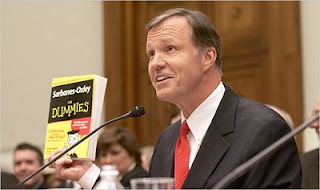
Below these remarks lies one of the more depressing articles in market history.
We see that the SEC has something called an "office of economic analysis". One wonders what they analyze. One only had to call any slightly sophisticated (on that note, I wrote about this on September 17, 2007) market participant and ask them what the ramifications would be.
And notice the tone..."it could have been much worse...we could have ignored everything and declared the equivalent of Martial Law on the markets and shut them down, so we should be thankful". Ah yes, what a master minister Mr. Cox is turning out to be.
Beyond that, the Treasury and Fed should be asked why they created "intense pressure" for the SEC to enact the short-selling rule. Who put pressure on the SEC to temporarily re-write existing rules...and for whose benefit?
By Rachelle Younglai
WASHINGTON (Reuters) - Under fire for regulatory missteps, top U.S. securities regulator Christopher Cox defended his agency's record but acknowledged some regrets over how he handled the worst financial crisis in decades.
The Securities and Exchange Commission has been lambasted by lawmakers and others for not doing enough to prevent the 2008 collapse of Bear Stearns and Lehman Brothers, interfering with markets and failing to detect the alleged $50 billion fraud at Wall Street financier Bernard Madoff's firm.
Cox, a Republican and former California congressman, said the SEC's focus has been customer protection and broker dealer regulation and that the agency "performed that traditional role superbly."
However, Cox said he had some regrets over a drastic action the agency took as markets were hurtling downward in September. For a few weeks, the SEC stopped investors from making bearish bets on financial stocks like Morgan Stanley (MS.N) and Citigroup (C.N).
The SEC's office of economic analysis is still evaluating data from the temporary ban on short-selling. Preliminary findings point to several unintended market consequences and side effects caused by the ban, he said.
"While the actual effects of this temporary action will not be fully understood for many more months, if not years, knowing what we know now, I believe on balance the commission would not do it again," Cox told Reuters in a telephone interview from the SEC's Los Angeles office late on Tuesday. "The costs appear to outweigh the benefits."
Less liquidity in the markets was one of the unintended consequences, experts have said.
The SEC imposed the temporary ban under intense pressure from the Federal Reserve and Treasury Department which insisted it was crucial to the short-term survival of these institutions, Cox said.
A few weeks after the temporary ban was lifted, global markets were again dropping precipitously, U.S. banks were begging the SEC to reinstate its short-sale ban and there was talk of shutting the markets down.
Cox said the chief executive of one major U.S. investment bank even urged suspension of normal trading rules across the entire U.S. market, likening the situation to how Abraham Lincoln suspended habeas corpus during the Civil War and Franklin Roosevelt sent Japanese-Americans to internment camps during World War Two.
The chief executive said, "that is how America made it through such crises, and we couldn't be too focused on maintaining the rule of law," Cox said. "That was advice we rejected."
Cox said he spoke to the White House, the chief executives the New York Stock Exchange and the Nasdaq, strongly urging them to keep the U.S. markets open.
Markets were never shut down and Wall Street investment banks weathered the market turmoil largely by transforming themselves into commercial banks.
It has been a rough year for Cox, who was recruited by the George W. Bush administration in 2005 to heal a fractious agency.
Initially, Cox managed to propose and adopt rules with little dissent from the agency's four other commissioners. He focused on modernizing the SEC, set a timetable for companies to submit financial reports with XBRL or interactive data, and reached agreements with the SEC's foreign counterparts to improve international enforcement.
Under Cox's watch, the agency also brought the second-highest number of enforcement actions in 2008 since a record in 2003 when staff dealt with fallout from the high-profile implosion of Enron.
However, his tenure as SEC chief will be colored by his handling of Wall Street's meltdown.
Cox said he tries to keep the criticism in perspective.
"If you know that you are doing everything you can to improve conditions for investors and markets ... if you know that the team of professionals that is working on the mission is first-rate, that is ample comfort against what are sometimes hastily drawn conclusions by others."
Collectivist Zombies
More of a rant today as vacation was no panacea for markets...
Pope Benedict, in his Christmas address from the Vatican, stated the following:
“In each of these places may the light of Christmas shine forth and encourage all people to do their part in a spirit of authentic solidarity,” the Pope said. “If people look only to their own interests, our world will certainly fall apart.”
While I certainly cannot disagree about the spirit of Christmas, I would vehimently disagree with this notion the world being a better place if only people ignored their self-interest.
Going beyond the impossibility of such a situation given human nature (and ignoring definitional problems of what "self-interest" means), it is extremely dangerous when people DO consider something more important than their self-interest. Collectivism, promulgated by nations, organizations, etc., has a far better chance to make the world "fall apart" than individuals cooperating with other individuals in the furtherance of their several selfish interests.
Subordination of self interest leads, by definition, to individuals acting for the furtherance of other people's goals, without due compensation or contract. Given human nature, this is not good.
And readers here will see where this is going. Economic conditions determine behavior. When conditions are bad (as they are now), deviation from self-interest can turn whole populations into Zombies. The human need for social interaction with like-minded individuals is, thank goodness, very strong...but this need can be subverted in difficult economic times to the great advantage of nations who have unstable populations, weak neighbors, and a need to place blame on someone "else" for their current predicament.
Subscribe to:
Posts (Atom)